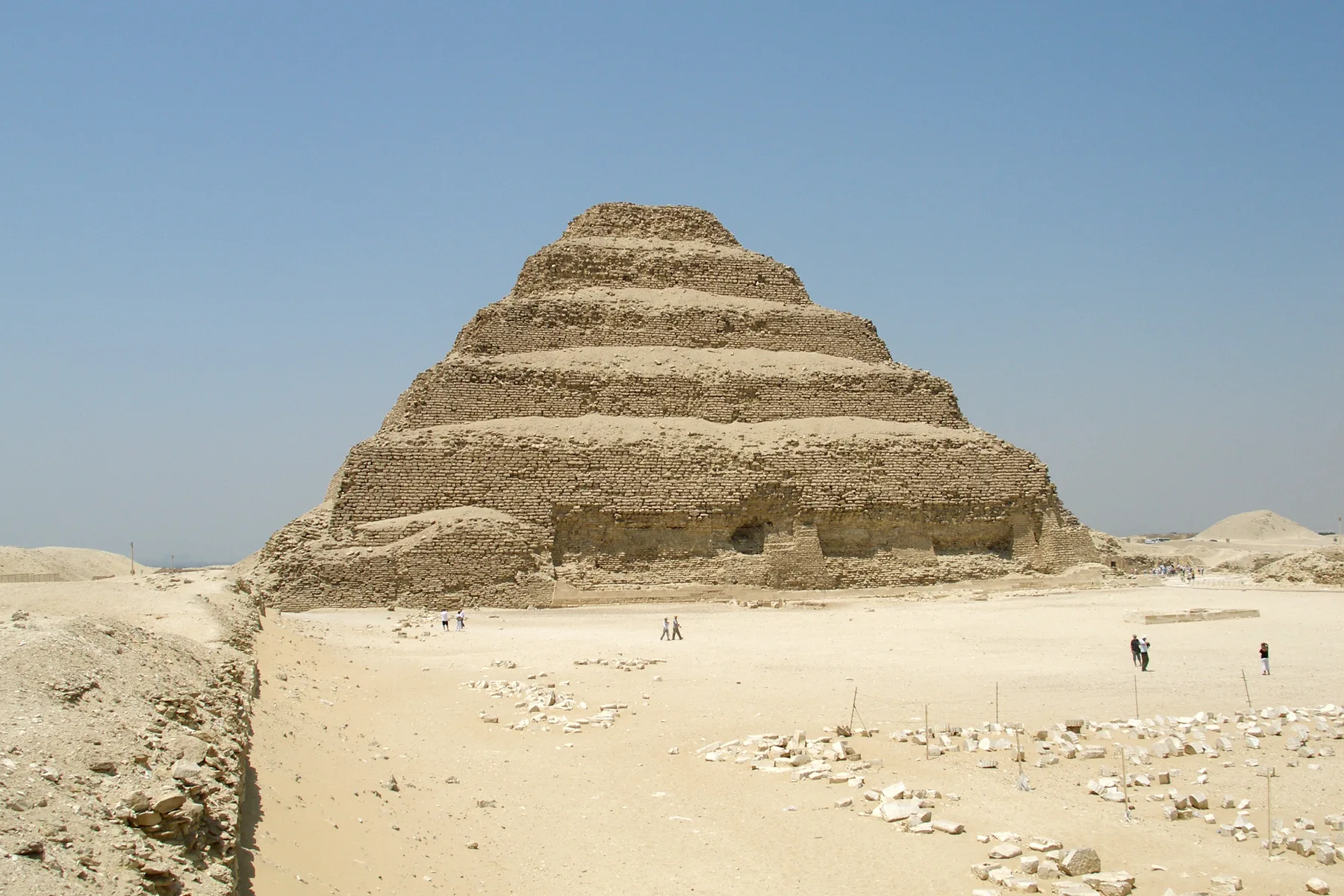
A century-scale reading of experiments, corrections, labour and landscape between the Step Pyramid and the Giza plateau. This is a method for reading evidence, not a simulation of certainty or an invented first-person visit.
READING 01 / T−02
Start below the pyramid
The familiar silhouette depends on older mastaba forms, underground chambers, enclosure walls and ritual movement. Height is only one part of the invention.
What supports it
Plans and construction phases preserve decisions hidden by the finished exterior.
Where certainty stops
A monument’s present restored profile can flatten the sequence of experiments.
ASK THE TIMELINEWhat had to exist before stacking stone became meaningful?
OBSERVATION Write one feature that another reader could verify.
CONTEXT Record where, when and how the evidence was found or documented.
INTERPRETATION Use comparison, then state the degree of uncertainty.
READING 02 / T−02
The Step Pyramid changed while rising
Djoser’s complex expanded through multiple stages. Reading those stages replaces the myth of one perfect drawing executed without revision.
What supports it
Changes in masonry and plan document design decisions during construction.
Where certainty stops
The surviving fabric has been repaired, stabilized and interpreted across generations.
ASK THE TIMELINEWhere can a correction be more informative than a finished surface?
OBSERVATION Write one feature that another reader could verify.
CONTEXT Record where, when and how the evidence was found or documented.
INTERPRETATION Use comparison, then state the degree of uncertainty.
READING 03 / T−02
Failure belongs in the sequence
Meidum, the Bent Pyramid and the Red Pyramid make engineering development visible. “Failure” is useful only when it does not erase continued use or ancient intentions.
What supports it
Angles, masonry arrangement and structural cracks allow comparison between projects.
Where certainty stops
Modern labels can mistake later damage for a simple ancient success-or-failure verdict.
ASK THE TIMELINEWhich problem does the next building appear to answer?
OBSERVATION Write one feature that another reader could verify.
CONTEXT Record where, when and how the evidence was found or documented.
INTERPRETATION Use comparison, then state the degree of uncertainty.
READING 04 / T−02
Labour leaves a settlement
Workers’ housing, food remains, tools, burials and team names replace fantasies of anonymous masses with evidence for organized skilled labour.
What supports it
Settlement archaeology connects monuments to provisioning and administration.
Where certainty stops
Evidence does not describe every worker, season or form of obligation.
ASK THE TIMELINEWhat changes when builders are studied through meals and homes, not just stone blocks?
OBSERVATION Write one feature that another reader could verify.
CONTEXT Record where, when and how the evidence was found or documented.
INTERPRETATION Use comparison, then state the degree of uncertainty.
READING 05 / T−02
Precision is social technology
Surveying, quarrying, transport and repeated measurement required institutions as well as techniques. Geometry alone did not feed or coordinate a workforce.
What supports it
Tool marks, quarry traces, alignments and administrative records address different parts of the process.
Where certainty stops
No single surviving text provides a complete construction manual for the Great Pyramid.
ASK THE TIMELINEWhich parts of the system are technical, political and logistical at once?
OBSERVATION Write one feature that another reader could verify.
CONTEXT Record where, when and how the evidence was found or documented.
INTERPRETATION Use comparison, then state the degree of uncertainty.
READING 06 / T−02
A plateau is a designed landscape
Causeways, temples, cemeteries and sightlines place pyramids inside changing ritual and social space. The postcard view removes most of this system.
What supports it
Spatial relationships show how approach, visibility and cult were organized.
Where certainty stops
Modern roads, excavation spoil and tourism routes change how the plateau is experienced.
ASK THE TIMELINEHow would the complex read if the pyramid were not the first object named?
OBSERVATION Write one feature that another reader could verify.
CONTEXT Record where, when and how the evidence was found or documented.
INTERPRETATION Use comparison, then state the degree of uncertainty.
SCALE TEST / T−02
Change the zoom
Minutes to years
Material, manufacture, use, repair, deposition, excavation and display.
Years to generations
Building phases, routes, neighbourhoods, abandonment and reuse.
Generations to centuries
Exchange, institutions, environment, language and political authority.
Discovery to today
Collection, conservation, nationalism, tourism and community claims.
SOURCE PROTOCOL / REVIEWED 17 July 2026
Keep an audit trail
- Identify the claim. Separate the date, description and interpretation.
- Prefer recorded context. Object labels are entry points, not complete excavation records.
- Compare source types. Text, material and later memory answer different questions.
- Date the source itself. A modern reconstruction has its own history and assumptions.
- Preserve disagreement. Do not merge competing chronologies into false consensus.
- Revise visibly. New evidence should change the page and its review date.